Tampa, Florida

Land Clearing Services in Tampa, FL

Brush clearing, selective clearing, and full site preparation for construction, reclaimed lots, and overgrown properties throughout Tampa. Every project begins with an on-site assessment and a written, no-obligation estimate.

Land clearing service in Tampa, Florida
Site Preparation

What Land Clearing Involves

Land clearing covers a much broader scope than a single-tree service like tree removal. Rather than addressing one hazardous or unwanted tree, land clearing takes on an entire lot, section of property, or overgrown parcel — clearing brush, undergrowth, smaller trees, vines, and accumulated debris to bring the land back to a usable, workable condition.

The scope of a clearing project varies widely depending on the goal. Some jobs are about preparing a building footprint for new construction, where the area needs to be completely cleared, graded, and made accessible to construction equipment. Others are about reclaiming a vacant or long-neglected lot that's grown dense with volunteer trees, invasive vines, and years of untouched brush — work that's less about construction and more about restoring the land to a maintainable state.

Not every clearing project means removing everything on the lot. Selective clearing is common on residential properties and sites with mature specimen trees worth preserving — underbrush, smaller trees, and unwanted vegetation are cleared out while specific trees are marked and protected throughout the process. This approach takes more care and planning than a full clear-cut, but it's often the better fit when a property owner wants to open up a space without losing the trees that give it character.

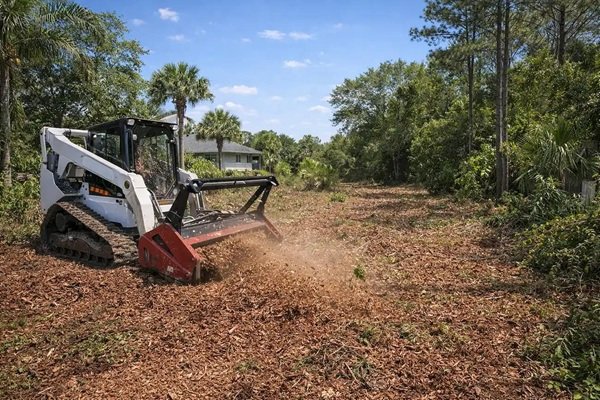
Equipment on a land clearing job typically includes forestry mulchers, skid steers, and excavation machinery suited to the density and terrain of the site — a different toolkit than what's used for a single tree removal, reflecting the difference in scale.

When It's Needed

Common Reasons for Land Clearing

Land clearing projects come from a range of starting points — some planned well in advance, others prompted by a property that's simply gotten away from its owner over time.

🏗️

New Construction

Preparing a building footprint and access routes ahead of a new home, addition, or commercial structure.

🌿

Overgrown Vacant Lots

Reclaiming a neglected lot that's developed dense brush, volunteer trees, and invasive vegetation over time.

📐

Development & Subdivision Prep

Clearing larger parcels ahead of subdividing land or preparing multiple building sites.

🚜

Agricultural & Pasture Use

Clearing brush and undergrowth to convert a wooded area into usable pasture or agricultural space.

🔥

Fire & Hazard Reduction

Removing dense, dry undergrowth that presents a fire risk or hides structural hazards close to a property.

🏡

Reclaiming Usable Yard Space

Opening up an overgrown section of a residential lot for landscaping, a pool, or outdoor living space.

How It Works

Our Land Clearing Process

Every land clearing project follows the same general sequence, scaled to the size of the property and adjusted for the density of vegetation and any trees being preserved. See the full range of offerings on the services page.

01

Site Walkthrough

The property is walked to assess vegetation density, tree condition, terrain, and access for equipment.

02

Clearing Plan

The scope is defined — full clearing or selective clearing — and any trees to be preserved are marked.

03

Brush & Undergrowth Removal

Dense brush, vines, and smaller vegetation are cleared using mulching or cutting equipment.

04

Tree & Stump Work

Unwanted trees are removed and stumps addressed as part of the overall clearing scope.

05

Debris Handling

Cleared material is mulched on-site, piled, or hauled away depending on the project and site plan.

06

Final Site Review

The cleared area is reviewed against the original plan to confirm the scope was completed as agreed.

Choosing an Approach

Full Clearing vs. Selective Clearing

Not every project calls for the same level of clearing. The right approach depends on what the land is being prepared for, and whether any existing trees are worth keeping.

FactorFull ClearingSelective Clearing
ScopeRemoves all vegetation and treesRemoves brush and unwanted trees only
Best suited forConstruction footprints, full site prepResidential lots, specimen tree preservation
Planning involvedMore straightforward, uniform approachRequires marking and protecting specific trees
Site appearance afterFully open, graded groundOpened space with mature trees intact
Typical use caseNew builds, parking areas, subdivisionsYard reclamation, landscaping projects

An on-site walkthrough is the best way to determine which approach fits a specific property, especially when mature trees are part of the equation.

Property Types

Residential & Commercial Land Clearing

Land clearing needs differ significantly depending on the size and purpose of the property.

Residential Land Clearing

Homeowners typically request clearing to reclaim an overgrown section of a lot or prepare for a specific project. Common priorities include:

  • Clearing a wooded section of yard for landscaping
  • Removing invasive vines and volunteer growth
  • Preparing ground for a pool, shed, or addition
  • Preserving mature trees while opening up usable space

See broader options for a single-property yard on the residential tree service page.

Commercial & Development Land Clearing

Developers, builders, and commercial property owners often need larger-scale clearing ahead of construction or site work. Common priorities include:

  • Clearing a full building footprint and access routes
  • Preparing larger parcels ahead of subdivision or development
  • Coordinating clearing timelines with construction schedules
  • Documentation suitable for permitting and project records

Learn more about ongoing maintenance on the commercial tree service page.

Before Clearing Begins

Environmental & Permit Considerations

Land clearing in the Tampa area often involves more regulatory considerations than a single tree removal, particularly on larger parcels. Certain protected tree species, wetland buffers, and conservation areas can restrict what's permitted to be cleared, and requirements vary depending on the property's zoning and location within the City of Tampa or unincorporated Hillsborough County.

Florida properties can also involve protected wildlife considerations — undeveloped and semi-wooded lots in this region sometimes support species such as the gopher tortoise, which is protected under state regulations and can affect the timing and method of clearing if burrows are present. A site walkthrough before work begins is the best way to identify these factors early, rather than discovering them mid-project.

Erosion control is another practical consideration on larger clearing projects, particularly on sloped or sandy sites common throughout the region. Depending on the site and its next use, silt fencing or other erosion control measures may be recommended to prevent runoff once the vegetation that was previously holding the soil in place has been removed.

Frequently Asked Questions

Land Clearing FAQs

How much does land clearing cost in Tampa?

Cost depends on the size of the area, vegetation density, the number of trees involved, and how much debris needs to be hauled off-site versus mulched in place. A written estimate after an on-site assessment is the most reliable way to know cost.

What is the difference between land clearing and tree removal?

Tree removal generally addresses one or a few individual trees. Land clearing covers a broader area and typically includes brush, undergrowth, smaller trees, and debris across an entire lot.

Can specific trees be preserved during land clearing?

Yes. Selective clearing removes underbrush and unwanted vegetation while marking and protecting specific trees the property owner wants to keep.

Do I need a permit for land clearing in Tampa?

Permit requirements depend on the size of the area, presence of protected trees or species, and whether the property falls within a regulated zone. It's worth confirming with the City of Tampa or Hillsborough County before clearing begins.

What happens to the vegetation and debris after clearing?

Cleared vegetation can be mulched on-site, piled for burning where permitted, or hauled away entirely, depending on the size of the project and your preference.

Is land clearing necessary before building on a lot?

In most cases, yes. Construction typically requires a cleared, graded building footprint free of trees, stumps, and dense vegetation, along with clear access for equipment.

Can land clearing help with an overgrown or neglected lot?

Yes. Vacant or long-neglected lots often develop dense brush and invasive vegetation over time. Clearing restores the lot to a usable, maintainable condition.

Do you offer free estimates for land clearing?

Yes. A free, no-obligation estimate can be requested through the estimate form on this site or by phone. You can also reach out through contact or confirm coverage on the service areas page.

Related Services

Explore Related Tree Services

See the full list of services on the services page, or check the service areas page to confirm coverage near you.

Need Professional Land Clearing in Tampa?

Request a Free Estimate Today