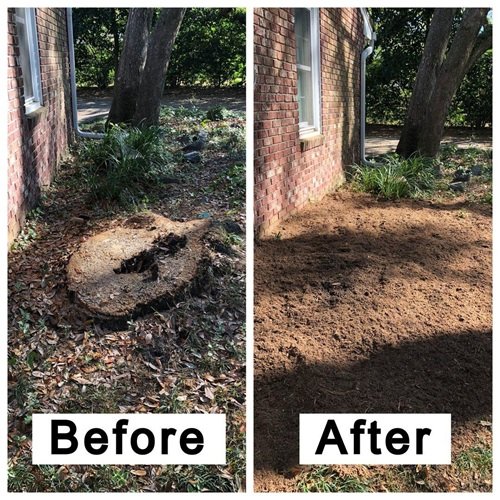
Full stump and root system extraction for properties that need more than grinding can offer — construction prep, replanting, drainage work, and complete site restoration — for homes and businesses throughout Tampa. Every job begins with an on-site assessment and a written, no-obligation estimate.
Stump removal goes a step further than stump grinding. Rather than shredding the stump and upper root mass down below grade, removal physically extracts the stump along with the major structural roots surrounding it, leaving little to no root material behind in that section of the ground. It's a more involved, more disruptive process, but it's the right choice whenever the site's next use requires that the ground actually be clear of root material — not just leveled over it.
The process typically involves excavation equipment to loosen and lift the root ball, cutting through larger roots that anchor the stump in place, and then hauling the extracted material off-site or setting it aside for disposal. Because this reaches deeper and wider than grinding does, it leaves a larger cavity that needs to be backfilled with soil and compacted before the area is ready for its next use.
Removal is generally reserved for situations where grinding wouldn't fully solve the problem: a new structure or foundation footprint, a driveway or paved surface planned for that exact spot, a septic or drainage line running through the area, or a replacement tree that needs undisturbed soil rather than a bed of old root material to grow into.
For yards where the goal is simply a clean, level surface for grass or landscaping, stump grinding is typically the more practical and less invasive option — it's worth reading both pages before deciding which service actually fits a specific project.
Grinding is sufficient for most residential situations, but there are specific circumstances where the root system genuinely needs to come out of the ground, not just be shredded in place.
A building addition, garage, or shed footprint needs a clear, stable foundation area free of buried root material.
Paved surfaces require compacted, uniform soil beneath them — remaining roots can settle unevenly and crack the surface over time.
Pool excavation typically requires a completely clear area, since old roots can interfere with the dig or the structure's base.
A new tree planted in the exact same location generally establishes better in fresh soil than in ground still full of old root material.
Trenching for drainage lines or septic systems often requires the removal of any root material in the excavation path.
Certain species with aggressive, spreading roots may need full removal to prevent ongoing interference with nearby plumbing or foundations.
Full stump removal follows a more involved sequence than grinding, reflecting the extra excavation and site restoration involved. See the full range of offerings on the services page.
The stump's size, root spread, and soil conditions are evaluated, along with nearby utilities or structures.
An approach is chosen based on equipment access, root depth, and how much of the surrounding area can be disturbed.
Major structural roots anchoring the stump are cut to allow the root ball to be loosened and lifted.
The stump and root ball are lifted out of the ground using excavation equipment suited to the site.
The extracted stump and root material are hauled away or set aside for disposal as agreed in the estimate.
The resulting cavity is backfilled with soil and compacted so the area is stable and ready for its next use.
Full removal projects look different depending on the property and what's planned for the cleared area afterward.
Homeowners typically request full removal when a specific project depends on clear ground. Common priorities include:
See broader options for a single-property yard on the residential tree service page.
Commercial properties often need full removal ahead of construction, paving, or site redevelopment projects. Common priorities include:
Learn more about ongoing maintenance on the commercial tree service page.
How a root system behaves during removal depends heavily on both the species and the soil it's grown in. Tampa's mix of sandy soils drains quickly and tends to allow roots to spread wider and shallower than they might in denser clay soils, since roots generally follow the path of least resistance toward moisture and nutrients. That shallow, wide-spreading pattern is actually an advantage during excavation in many cases, since it reduces how deep the removal needs to go, even if it means clearing a wider area at the surface.
Species also matters. Live oaks and other mature hardwoods common throughout Tampa's older neighborhoods tend to develop substantial structural roots close to the trunk, which take more effort to cut through during extraction. Faster-growing, softer-wooded species are often quicker to remove but can also have spread their roots further from the trunk in search of water, which sometimes means the excavation area needs to extend beyond what the visible stump size would suggest.
Because of this variation, an accurate estimate for full stump removal depends on seeing the specific stump, species, and site — not just a general size estimate from a photo or a phone description.
Cost depends on the stump's size, root spread, soil conditions, and how much excavation and site restoration the job requires. Full removal generally costs more than stump grinding since it involves extracting the entire root structure.
Full removal is generally used when a structure, foundation, driveway, pool, or septic line is planned for the same spot, or when a new tree needs to be replanted in the exact location without competing root material.
Most root systems spread laterally near the surface rather than growing straight down, though larger structural roots close to the trunk can extend a few feet deep depending on species and soil conditions.
Yes, removal typically leaves a larger excavation cavity than grinding does, since the root ball itself is extracted. The area is backfilled and leveled with soil once the stump and major roots are removed.
It can, if the root system runs near irrigation lines, buried utilities, or a neighboring tree's root zone. A site assessment before work begins identifies these risks so excavation can be planned accordingly.
Removing the stump and the bulk of the root system generally reduces the chance of new sprouts more thoroughly than grinding alone, since more of the live root material is taken out of the ground.
Timing depends on the stump's size, root spread, and soil conditions, but full removal generally takes longer than grinding because it involves more extensive excavation and backfilling.
Yes. A free, no-obligation estimate can be requested through the estimate form on this site or by phone. You can also reach out through contact or confirm coverage on the service areas page.
See the full list of services on the services page, or check the service areas page to confirm coverage near you.
Quick Request
Can't connect with us by phone? Message us with the service you need. Send your request and we'll get back to you within 15 minutes.