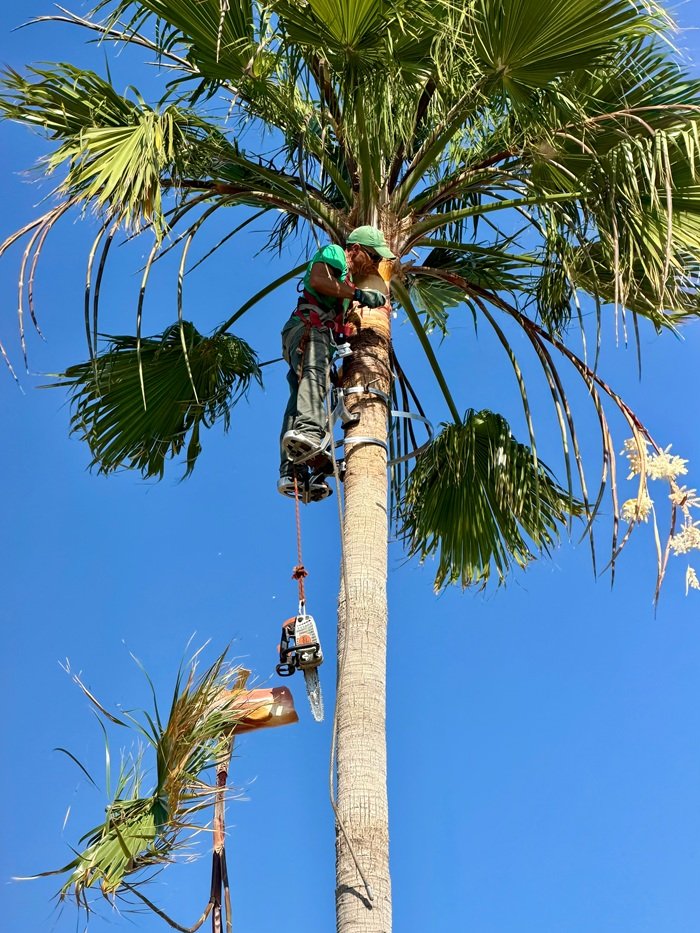
Safe, planned removal of diseased, hazardous, and storm-damaged palm trees for homes and businesses throughout Tampa, including crane-assisted removal for tall specimen palms. Every job begins with an on-site assessment and a written, no-obligation estimate.
Palm tree removal is a different discipline from hardwood tree removal, and treating a palm like a live oak or pine during removal is one of the more common mistakes in the industry. Palms have a single growing point at the top of the trunk, no branching structure to rig from, and a fibrous, mat-like root system instead of a deep taproot. Every part of the removal process — how weight is calculated, where rigging lines attach, how the trunk is sectioned, and how the root ball is dealt with afterward — depends on understanding that difference.
Because a palm's canopy is concentrated entirely at the crown, a mature specimen carries most of its weight at the very top of a single, tall column. That changes how a felling plan is built. Where a hardwood might be dropped as several separate limbs and a trunk, a palm is usually approached as a single trunk with a heavy crown, removed in controlled sections from the top down when space is limited.
Tampa's mix of mature Sabal palms, Canary Island Date Palms, Queen Palms, and King Palms adds another layer of variation. Each species differs in trunk density, frond weight, height potential, and how it tends to fail when diseased or storm-damaged, which is why a palm removal plan is built around the specific tree in front of the crew rather than a one-size-fits-all approach.
Removal is typically the right call once a palm is confirmed dead, is in advanced decline from disease, or has become structurally unsafe near a structure, driveway, or power line. In earlier stages, some issues can still be addressed — see palm tree trimming for ongoing frond maintenance that supports a palm's long-term health.
Palms are generally hardy trees, but a number of conditions can push a specific palm from "worth monitoring" to "needs to come down." An arborist assessment is the most reliable way to confirm which of the following applies to a particular tree, since some of the more serious issues aren't obvious from the ground.
A bacterial disease affecting several common Florida palm species, causing progressive frond discoloration and canopy decline that is not treatable once symptoms are advanced.
A related disease primarily affecting date palms, leading to progressive frond loss and eventual death of the growing point, often requiring removal once confirmed.
A fungal disease that decays the base of the trunk from the inside out, weakening structural integrity long before any visible conk appears at the base.
A snapped trunk, a damaged or lost growing point, or a significant lean following a storm can leave a palm unsafe to keep in place.
A palm growing too close to a roofline, driveway, pool, or power line presents an ongoing risk regardless of its current health.
Once a palm's growing point has died, the entire tree is no longer viable and typically becomes a falling hazard over time.
Every palm removal follows the same careful sequence, adjusted for the palm's species, height, condition, and surroundings. The goal throughout is a controlled removal that protects the property and anyone nearby. See the full range of offerings on the services page.
The palm's species, height, lean, trunk condition, and proximity to structures or power lines are evaluated in person.
A felling or sectional approach is chosen based on the site, including whether crane assistance is needed.
The crown and fronds are removed first on taller specimens, reducing weight before the trunk is sectioned.
The trunk is lowered in controlled sections, using rope, rigging, or a crane depending on access and space.
Sectioned trunk pieces and frond debris are cleared from the property as part of the job.
The remaining root ball can be ground down or removed to fully reclaim the planting area.
Palm removal priorities shift depending on the property, the number of palms involved, and how visible the trees are to the public.
Homeowners are typically dealing with a single palm, or a small cluster, near the house, pool, or driveway. Common priorities include:
See broader options for a single-property yard on the residential tree service page.
HOAs, apartment communities, and commercial landscapes often manage rows of specimen palms along entrances, parking lots, and common areas, where appearance and liability both matter. Common priorities include:
Learn more about ongoing maintenance on the commercial tree service page.
Tampa's landscape includes a number of mature Canary Island Date Palms, tall Washingtonias, and other specimen palms that can reach well beyond the height of a typical two-story home. Once a palm grows past what rope and manual rigging can safely control, crane assistance becomes the more practical and often safer option — particularly when the palm sits close to a house, a pool enclosure, or a shared property line where there's little margin for error.
A crane allows the crown and trunk sections to be lifted and set down in a controlled location rather than lowered piece by piece by hand, which reduces the time crews spend working at height on an unstable trunk and reduces the risk to anything below. This approach is generally reserved for palms where access allows a crane to be positioned safely, and where the height or site constraints make rope-based rigging alone impractical.
Not every tall palm requires a crane — trunk diameter, exact height, surrounding obstacles, and access all factor into whether rigging alone is sufficient. That determination is made during the on-site assessment, and reflected in the written estimate before work begins.
Tampa's palm population is more varied than many property owners realize, and species differences affect both disease risk and how a removal is approached. The Sabal palm, Florida's state tree, is common throughout the region and is relatively disease-resistant, though older specimens can still develop internal decay at the base. Queen Palms are fast-growing and widely planted for their full, arching canopy, but they are also among the species most affected by lethal bronzing, which makes early monitoring important.
The Canary Island Date Palm is a large, heavy-trunked species often used as a specimen or entrance planting — its size and weight make it one of the more likely candidates for crane-assisted removal when the time comes. King Palms and Areca Palms are common in more ornamental or clustered plantings and tend to be smaller in stature, which usually simplifies removal even when a specimen is diseased or storm-damaged. Washingtonia palms, both Mexican and California varieties, are known for growing tall quickly and are frequently the specimens that eventually require crane assistance due to sheer height.
Because susceptibility to disease and typical failure patterns vary by species, identifying the palm correctly is one of the first steps in any removal assessment — it shapes both the urgency of the recommendation and the equipment the job will require.
Because some of the most serious palm diseases progress internally, visible warning signs often appear only after a palm's structural integrity is already compromised. Property owners are generally better served erring on the side of an assessment when any of the following are present, rather than waiting to see if the palm improves on its own.
Frond discoloration spreading from the lower canopy upward is one of the more recognizable signs of disease progression, particularly with lethal bronzing and Texas Phoenix palm decline, both of which are common in Central Florida. A collapsed or dying spear leaf — the newest, unopened frond at the very top of the crown — is often one of the clearest indicators that the growing point itself is failing, at which point the palm cannot recover. Visible conks or soft, spongy tissue at the base of the trunk point to internal decay from butt rot, which weakens the trunk's structural integrity well before any external lean is visible.
A noticeable lean that has developed or worsened, especially after a storm, can indicate root or soil failure rather than a naturally curved trunk, which is common in some healthy palms. Fungal growth, cracks, or splitting anywhere along the trunk also warrant a closer look, since palms don't heal the way hardwoods do — once trunk tissue is compromised, it stays that way. Any of these signs are reasonable grounds for a professional risk assessment before the situation progresses further.
Cost depends on the palm's height, species, trunk diameter, and proximity to structures or power lines. A tall specimen requiring crane assistance costs more than a smaller palm in an open yard. A written estimate after an on-site assessment is the only reliable way to know cost for a specific palm.
Some of the most serious palm diseases, including lethal bronzing and Texas Phoenix palm decline, can progress internally before obvious symptoms appear in the canopy. By the time fronds show clear decline, the palm may already be a falling hazard.
Yes, generally. A dead palm loses structural integrity at the crown and along the trunk, and fronds or the entire crown can detach with little warning.
In some cases, yes. Nutrient deficiencies and early-stage issues can sometimes be corrected with treatment, and storm-damaged palms with an intact growing point often recover. A professional assessment determines whether treatment or removal is the right course of action.
Stump grinding or root ball removal can be completed as part of the job or scheduled separately. Palm root systems are fibrous rather than a single taproot, which affects the approach compared to hardwood stump grinding.
Permit requirements depend on the palm species, size, and location, and certain protected specimens may require approval from the City of Tampa or Hillsborough County even on private property.
Tall palms close to a structure are typically removed in sections from the top down, using rigging or crane assistance to control where each piece lands, protecting roofs, driveways, and landscaping during the removal.
Yes. A free, no-obligation estimate can be requested through the estimate form on this site or by phone. You can also reach out through contact or confirm coverage on the service areas page.
See the full list of services on the services page, or check the service areas page to confirm coverage near you.
Request a Free Estimate Today
Quick Request
Can't connect with us by phone? Message us with the service you need. Send your request and we'll get back to you within 15 minutes.