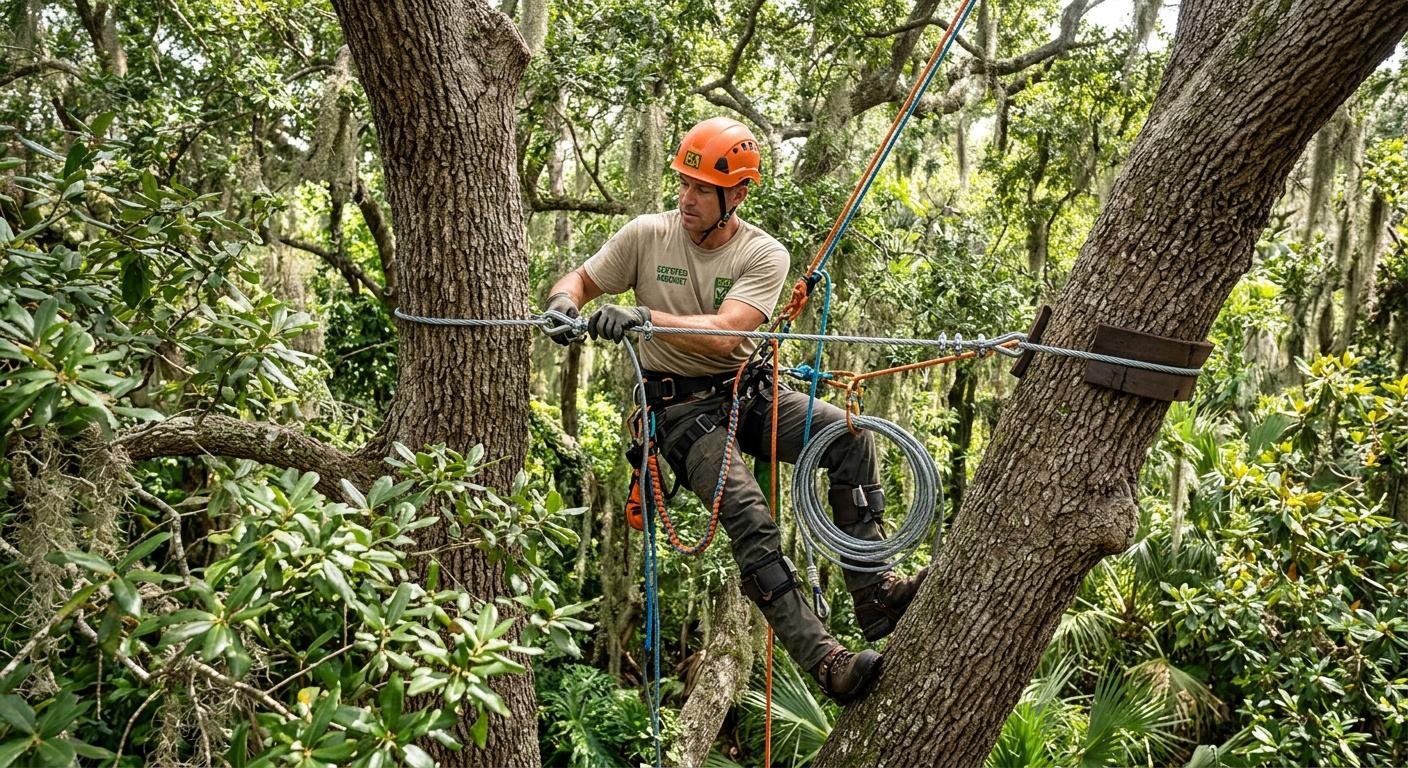
Structural support systems that reduce the risk of limb or trunk failure in trees with weak branch unions, co-dominant stems, or heavy limbs — often allowing a valued tree to remain in place instead of being removed. Every project starts with an on-site assessment and a written, no-obligation estimate.
Tree cabling and bracing are structural support techniques used to reduce the risk of limb or trunk failure in trees with weak branch unions, co-dominant stems, or heavy limbs — without requiring the tree to come down. Rather than correcting the issue through cuts, as pruning does, cabling and bracing add physical support directly to the tree's existing structure.
Cabling typically involves installing flexible steel cables higher in the canopy, connecting two or more major limbs so that if one begins to fail, the cable limits how far it can move. Bracing works differently: rigid steel rods are installed through the trunk or at a split, providing direct support against separation at a specific point of weakness, such as a co-dominant stem with a narrow, included-bark union.
These systems are most valuable for large, mature trees where the structural issue is isolated — a single weak union, a heavy horizontal limb, or a split that hasn't fully failed — rather than widespread decay or root failure throughout the tree. In those more limited cases, cabling and bracing can extend a tree's safe lifespan by years, particularly for trees too large or too valuable to lose to removal over a single correctable weakness.
Installation isn't a one-size-fits-all process. The right system depends on the tree's species, size, canopy shape, and the specific structural issue involved, which is why a hands-on assessment always comes before any hardware goes in.
Different structural problems call for different hardware. An arborist assessment identifies which of the following, if any, apply to a specific tree.
Rigid steel cable installed between major limbs to limit movement and reduce strain on a weak branch union.
Cable systems with built-in flexibility that allow natural limb movement in wind while still limiting excess strain.
Rigid steel rods installed through the trunk or at a split to provide direct support against further separation.
Combined cabling and bracing used where two main stems compete for dominance and share a weak, narrow union.
Support systems designed around a trunk cavity or hollow section, reinforcing structural integrity where wood has been lost.
Supplemental anchoring used in specific cases where a tree's root plate needs additional stability.
Certain structural patterns are common indicators that a tree could benefit from cabling or bracing rather than pruning alone. Co-dominant stems — two trunks of similar size growing from roughly the same point — are one of the most frequent candidates, especially when the union between them includes bark rather than solid wood, a condition that weakens the connection over time. Heavy, horizontal limbs on mature trees, common on wide-spreading live oaks throughout Tampa's older neighborhoods, can also benefit from cabling as they extend further from the trunk and accumulate weight with age.
Trees with a history of previous storm damage — a limb that cracked but didn't fully detach, or a split that was caught early — are often good candidates for bracing rather than removal, provided the rest of the tree remains structurally sound. Visible cracks at a branch union, even small ones, are worth having assessed before they progress further. Finally, trees with particular value to a property — mature specimens, trees providing significant shade, or trees that would be costly or slow to replace — are frequently supported with cabling systems specifically to avoid the alternative of full removal.
Installing a support system is a deliberate process, not a quick add-on to a routine visit. See the full range of offerings on the services page.
The tree's branch unions, co-dominant stems, and overall canopy weight distribution are evaluated in detail.
Cabling, bracing, or a combination is chosen based on the specific weakness identified.
Attachment points are selected to distribute support effectively without unnecessary damage to healthy tissue.
Cables or rods are installed using techniques appropriate to the tree's species and size.
The system is checked to confirm it's providing the intended support without over-restricting natural movement.
Support systems are periodically reviewed as the tree continues to grow around the installed hardware.
Homeowners often turn to cabling and bracing to preserve a specific tree that holds real value to the property — a large shade tree, a specimen oak, or a tree tied to the character of the yard. Common priorities include:
HOAs, office parks, and property managers often use support systems as part of a broader risk-management approach across a shared landscape. Common priorities include:
Learn more about ongoing maintenance on the commercial tree service page.
Support systems work best when a tree's structural weakness is limited and specific — a single co-dominant union, one heavy limb, an isolated crack. In these cases, cabling or bracing can address the exact point of concern while leaving the rest of a healthy tree intact.
They're not a fix for every situation. A tree with widespread trunk decay, a failing root system, or damage spread across multiple major limbs is generally beyond what cabling and bracing can safely correct, and in those cases removal is typically the more responsible option. If a tree has already failed or is actively hazardous, that's a different, urgent situation — see emergency tree removal.
An on-site assessment is the only reliable way to determine which category a specific tree falls into, and whether a support system is a viable long-term solution.
Structural support techniques that reduce the risk of limb or trunk failure in trees with weak branch unions, co-dominant stems, or heavy limbs, without requiring removal of the tree.
Cabling uses flexible steel cables installed higher in the canopy to limit relative movement between limbs. Bracing uses rigid steel rods, typically lower in the trunk or at a split, for direct support against separation.
In many cases, yes, when the structural weakness is limited to specific branch unions or a co-dominant trunk rather than widespread decay.
Properly installed hardware is designed to minimize impact, using techniques that avoid unnecessary damage to healthy tissue, and is typically installed by trained professionals.
Cabling and bracing hardware can remain effective for many years, but systems should be inspected periodically since the tree continues to grow around the installed hardware.
Large, mature trees with co-dominant stems, heavy horizontal limbs, previous storm damage, or included bark at a branch union are common candidates.
No. Cabling and bracing address existing structural weaknesses, while pruning removes deadwood and helps establish better structure going forward. The two are often used together.
Yes. A free, no-obligation estimate can be requested through the estimate form on this site or by phone. You can also reach out through contact or check service areas to confirm coverage near you.
See the full list of services on the services page, or check the service areas page to confirm coverage near you.
Quick Request
Can't connect with us by phone? Message us with the service you need. Send your request and we'll get back to you within 15 minutes.