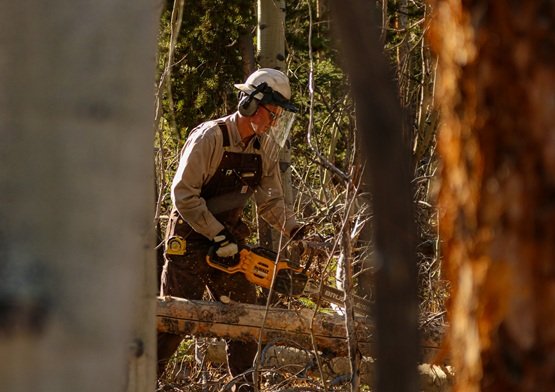
Controlled, precise tree cutting using directional felling, sectional dismantling, and rigging for homes and businesses throughout Tampa. Every job starts with an on-site assessment and a written, no-obligation estimate.
Tree cutting is the technical, hands-on part of taking a tree down — the specific methods used to fell or dismantle a tree safely, whatever the reason for the work. It sits underneath broader services like tree removal, which also covers debris hauling and stump handling, but the cutting itself is where precision and technique matter most.
No two trees are cut down the same way. A tree standing alone in an open yard, with no structures or fences within its fall radius, can often be dropped in a single directional cut. A tree wedged between a house, a driveway, and a neighbor's fence line calls for an entirely different approach — one built around cutting the tree apart piece by piece, with each section lowered under control rather than allowed to fall.
What separates professional tree cutting from a rough DIY attempt isn't just the equipment, though proper chainsaws, rigging, and rope systems matter. It's the planning that happens before the first cut: reading the tree's lean, understanding where its weight is concentrated, and deciding in advance exactly how each section will come down and where it will land.
Tree cutting isn't limited to full removals. Storm-damaged limbs, hazardous overhangs, and sections of a tree that need to come down while the rest stays standing all call for the same careful, cut-by-cut approach — closely related to the targeted work described on the tree pruning page, though generally applied at a larger scale.
The right cutting technique depends on the tree's size, lean, and surroundings. Most jobs use a combination of the following, decided during the on-site assessment before any cutting begins.
A notch-and-back-cut technique used to guide a whole tree to fall in a specific direction, suited to trees with enough open space around them.
Cutting a tree apart from the top down in smaller pieces, used when there isn't room for the tree to fall as a whole.
Using a crane to lift and remove large sections directly, reducing strain on rigging and improving control on very tall or heavy trees.
Rope systems that lower cut sections gradually instead of letting them drop, protecting whatever is below.
Slow, deliberate cuts and controlled lowering used when a tree is within falling distance of a home, fence, or vehicle.
Marked and cleared landing areas that keep each cut section away from people, pets, and property during the job.
Every cutting job follows the same disciplined sequence, adjusted for the tree's size, lean, and surroundings. See the complete range of offerings on the services page.
The tree's lean, size, and surrounding structures, fences, and lines are reviewed before any equipment is set up.
A decision is made between directional felling and sectional dismantling, along with the rigging needed.
The landing area is cleared and marked, and nearby property is protected before cutting begins.
The tree is felled whole or taken down section by section, depending on the plan.
Cut sections, limbs, and brush are moved off the property or staged for further processing.
The work area is checked and cleared, leaving the property clean once cutting is complete.
The scale and constraints of a cutting job change significantly depending on the type of property.
Homeowners typically need a single tree cut down in a yard bordered by fences, sheds, driveways, or a neighboring property. Common priorities include:
See broader options for a single property on the residential tree service page.
Commercial sites often involve larger trees, tighter scheduling windows, and more people nearby during the work. Common priorities include:
Learn more about ongoing maintenance on the commercial tree service page.
Cutting down a tree carries real risk, and most of that risk comes from factors that aren't obvious from the ground. A tree's actual lean is often different from how it appears at a glance, internal decay can shift how a trunk responds to a cut, and a limb under tension can snap back with enough force to cause serious injury. Professional cutting accounts for all of this before a chainsaw is ever started.
Proper equipment plays a direct role in managing that risk. Chainsaws are matched to the size of the tree, climbing gear and harnesses are used for aerial work, and rope systems are set up to control the speed and direction of falling sections rather than letting gravity decide. Personal protective equipment — chaps, helmets, eye and ear protection — is standard on every job, not an afterthought.
This is also why DIY tree cutting is discouraged, particularly for anything beyond small, ground-level limbs. A tree that looks straightforward from a distance can still behave unpredictably once cut, and a mistake with a chainsaw or a poorly planned fall can cause serious harm to the person doing the work, not just the property around it. If a tree has already fallen or is actively hazardous, that's a different, more urgent situation — see emergency tree removal for time-sensitive work.
Tree cutting and land clearing are often confused, but they solve different problems. Tree cutting deals with one tree, or a handful of specific trees, that need to come down for reasons of safety, space, or property planning. The rest of the landscape stays untouched.
Land clearing is a larger-scale project that removes all vegetation — trees, brush, undergrowth — across a defined section of a property, typically to prepare a site for construction, a new structure, or a significant landscaping change. It involves more equipment, more debris handling, and a different kind of planning than cutting down an individual tree.
If the goal is removing a single problem tree, this page covers what's involved. If the project is closer to clearing a lot or a large section of land, the land clearing page is the better starting point.
Tree cutting refers to the technical process of felling or dismantling a tree, while tree removal is the broader service that includes cutting the tree down along with hauling away debris and, if needed, grinding the stump.
Only when there is enough open space for the full tree to fall safely. Trees close to a home, fence, power line, or neighboring property are typically cut down in sections instead.
Cutting a tree, especially a large one or one near structures and power lines, carries significant risk from unpredictable falls and improper rigging. This work is best left to trained professionals.
Trees near a house are generally cut in controlled sections rather than felled whole, with each piece lowered by rope to a specific landing zone.
Common equipment includes chainsaws sized to the tree, climbing and rigging gear, rope systems for controlled lowering, and in some cases a crane for very tall or hard-to-access trees.
The City of Tampa and Hillsborough County regulate cutting or removal of certain protected trees, including many mature oaks, even on private property. Confirm requirements with the local permitting office or an arborist before work begins.
Trunk sections, limbs, and brush are typically hauled away from the property as part of the job, though some property owners choose to keep larger sections for firewood or milling.
Yes. Tree cutting typically deals with one or a few individual trees, while land clearing involves removing all vegetation across a defined area. You can also reach out through contact or check service areas to confirm coverage near you.
See the full list of services on the services page, or check the service areas page to confirm coverage near you.
Quick Request
Can't connect with us by phone? Message us with the service you need. Send your request and we'll get back to you within 15 minutes.