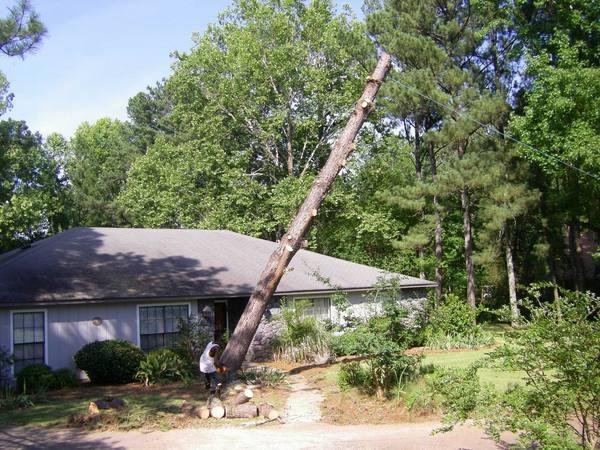
Risk assessment and safe removal for trees showing structural warning signs near homes, driveways, power lines, and high-traffic areas throughout Tampa. Every job begins with an on-site evaluation and a written, no-obligation estimate.
Hazardous tree removal is a different starting point than a routine tree removal request. Where standard removal is usually driven by a tree being unwanted, dead, or in the way of a project, hazardous tree removal starts with a specific safety concern — a tree that shows real structural warning signs and sits close enough to a home, driveway, power line, or walkway that its failure would actually matter.
Not every tree that looks rough is genuinely hazardous, and not every hazardous tree looks obviously bad from the ground. A tree can be structurally compromised well before its canopy shows any visible decline, which is exactly why hazard trees are evaluated as a category of their own rather than folded into general removal or trimming work. The evaluation looks past appearance and asks a more specific question: given this tree's condition, what's the realistic likelihood it fails, and what would it hit if it did?
That second half of the question — what's nearby — matters as much as the tree's condition itself. A significantly leaning tree in the middle of an open field carries a very different level of concern than the same lean on a tree standing twelve feet from a bedroom window. Risk isn't just about the tree; it's about the tree in relation to what's around it, sometimes referred to as the "target" in a formal risk assessment.
Once a tree is confirmed hazardous, removal is typically the recommended course of action, though in some cases targeted pruning, cabling, or bracing through tree cabling and bracing can address the specific weakness without requiring the tree to come down entirely.
Certain structural indicators consistently show up in trees that later fail, which is why they're treated as reliable warning signs during a risk assessment. Seeing one of these on a specific tree is a reasonable basis to request an evaluation, rather than waiting to see if the issue resolves on its own.
A lean that has visibly increased over time, or appeared suddenly after a storm, often points to root or soil failure rather than a naturally curved trunk.
Significant deadwood in the canopy, especially large-diameter limbs, presents a falling hazard even if the rest of the tree still appears healthy.
Conks or mushroom growth at the trunk base or root flare are a strong indicator of internal decay that can be well advanced before it's visible elsewhere.
Vertical cracks, seams, or splits in the trunk suggest the wood's structural integrity has already been compromised.
A visibly hollow trunk or major limb has lost much of the solid wood needed to support its own weight and resist wind load.
Roots that have been cut, compacted, or lifted from the soil — sometimes from nearby construction or a recent storm — reduce a tree's stability at the base.
A hazardous tree evaluation follows a structured process rather than a quick glance from the driveway. See the full range of offerings on the services page, or learn more about ongoing evaluations through arborist services.
The trunk, canopy, and visible root flare are examined for the structural warning signs outlined above.
Nearby structures, walkways, vehicles, and high-traffic areas are identified to understand what's at risk if the tree fails.
The tree's specific defects are weighed against species characteristics and site conditions to estimate failure risk.
Based on the findings, removal, pruning, cabling, or continued monitoring is recommended.
Findings are summarized in a written estimate, useful for property owners, HOAs, or insurance purposes.
Hazardous tree removal sits between two related services, and understanding the distinction helps clarify which situation applies.
| Factor | Routine Removal | Hazardous Removal | Emergency Removal |
|---|---|---|---|
| Trigger | Unwanted, in the way, or dead tree | Structural risk identified before failure | Tree has already fallen or is actively failing |
| Timing | Scheduled at convenience | Prioritized, but planned | Immediate response needed |
| Starting point | Property owner preference | Formal risk assessment | Visible, active hazard |
| Learn more | Tree Removal | This page | Emergency Tree Removal |
If a tree has already fallen, is actively leaning toward a structure, or has failed in some visible way right now, that's a time-sensitive situation covered under emergency tree removal rather than a scheduled hazard assessment.
What counts as an acceptable level of risk often depends on the property and who might be affected.
Homeowners are usually concerned with a specific tree near the house, driveway, or a space where family and guests spend time. Common priorities include:
See broader options for a single-property yard on the residential tree service page.
Commercial properties and HOAs generally carry a higher liability exposure due to foot traffic and shared responsibility across a site. Common priorities include:
Learn more about ongoing maintenance on the commercial tree service page.
Once a tree is confirmed hazardous, how it's taken down matters as much as the decision to remove it. A structurally compromised tree can behave less predictably during removal than a healthy one — a cracked trunk or hollow section may not hold weight or respond to rigging the way sound wood does, which changes how the crew approaches the cut sequence.
Proximity to the "target" identified during the risk assessment shapes the removal method directly. A hazardous tree standing in an open yard with no structures nearby may be manageable with standard sectional felling, while the same tree fifteen feet from a home or over a shared driveway usually calls for controlled, piece-by-piece removal using rope and rigging, or crane assistance where site conditions and space allow it.
Power lines add another layer of caution. A hazardous tree growing into or near utility infrastructure requires coordination with the utility company before work begins, since contact with energized lines is a serious and immediate danger that changes the entire approach to the job.
Certain conditions specific to the Tampa area make hazard identification a bigger priority here than it might be in other parts of the country. Sandy, well-draining soils common throughout the region hold roots less firmly than denser clay soils, which means a tree with an otherwise sound trunk can still become unstable if its root plate has been compromised by prolonged heavy rain or nearby construction.
The region's storm pattern compounds this. Repeated exposure to tropical storms and hurricane-season winds tends to reveal structural weaknesses over time — a tree that survives one storm season with a minor crack or a slightly worsened lean is often carrying hidden damage into the next one, even if no new problems are visible from the ground in between. This is part of why a one-time assessment isn't always enough; trees near structures often benefit from being checked again after any significant storm, not just when something looks obviously wrong.
Older, established neighborhoods with mature live oaks and other large hardwoods add another layer to this picture. These trees have often grown for decades in proximity to homes built long after the tree was already established, which means the "target" side of the risk equation — what's actually nearby — has usually changed even when the tree itself hasn't. A tree that once stood in an open lot may now overhang a roofline it never used to reach.
A hazardous tree shows specific structural warning signs, such as a worsening lean, large dead limbs, trunk cracks, or fungal growth at the base, rather than simply looking untidy. A professional risk assessment can distinguish the two.
It evaluates a tree's structural condition alongside what it could hit if it failed, considering lean, root and trunk integrity, deadwood, and proximity to structures or high-traffic areas.
Not necessarily. Some trees naturally grow with a permanent lean and remain structurally sound. A lean that has visibly increased over time, or appeared suddenly after a storm, is a stronger warning sign.
In some cases, yes. Cabling, bracing, or targeted pruning can address certain structural weaknesses. Once a tree has significant trunk or root failure, removal is typically safer.
Liability generally depends on the specific circumstances and is a legal question best directed to an attorney or your insurance provider. A documented risk assessment is one practical step property owners can take.
They're typically removed in controlled sections using rope and rigging, or with crane assistance for larger or more constrained sites, to control exactly where each piece lands.
Coverage varies by policy and by whether the tree has already caused damage or is identified as a risk beforehand. Removing a hazardous tree proactively is generally the property owner's responsibility; check your specific policy.
Yes. A free, no-obligation estimate can be requested through the estimate form on this site or by phone. You can also reach out through contact or confirm coverage on the service areas page.
See the full list of services on the services page, or check the service areas page to confirm coverage near you.
Request a Free Estimate Today
Quick Request
Can't connect with us by phone? Message us with the service you need. Send your request and we'll get back to you within 15 minutes.