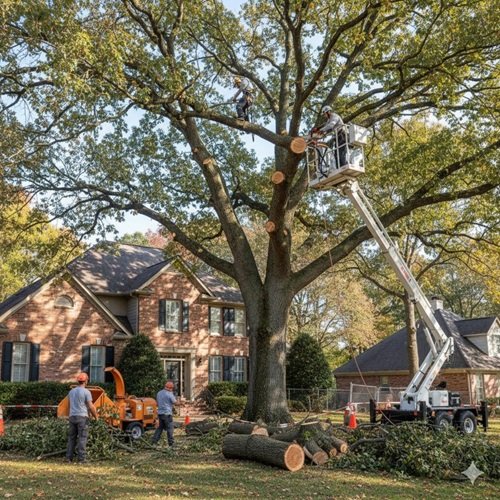
Safe removal of dead, hazardous, or unwanted oak trees for homes and businesses across Tampa, with clear guidance on permit requirements for protected specimens.
Live oaks and laurel oaks are some of the most common large trees on residential and commercial properties across Tampa, and for good reason — few trees provide the same amount of shade or the same broad, sculptural canopy. That size is exactly what makes oak tree removal a different job than removing a smaller ornamental tree. A mature oak can weigh many tons, spread its canopy well beyond the trunk, and send roots out far past the drip line, all of which shape how a removal has to be planned.
Removal becomes the right call for an oak when it's dead, in advanced decline, structurally compromised by decay or storm damage, or growing in a spot where its size has become an ongoing risk to a home, driveway, or utility line. Because oaks are large, heavy trees, removal is almost always done in carefully planned sections rather than as a single cut, with rigging used to control exactly where and how each piece comes down. Getting that sequencing right matters more with oaks than with most other trees, simply because of how much weight and canopy area is involved in even a single section.
One detail specific to oaks in this area is worth flagging early: many mature oaks are protected under local tree ordinances, which means removal may require a permit even on private property. That's worth confirming before any cutting begins, not after. For a broader look at removal in general, see the main tree removal page.
It's also worth noting that oak removal isn't always an all-or-nothing decision made in a single visit. Many property owners start with a conversation about what's actually going on with the tree — whether the concern is a specific dead limb, a section of decline in an otherwise healthy canopy, or a tree that's simply grown too large for its location over the decades. That distinction matters, because it changes whether the right next step is full removal, targeted pruning, or a closer inspection first.
Oaks are generally sturdy, long-lived trees, but certain conditions are worth having checked out by a professional rather than waiting to see how they develop.
A visible hollow or cavity in the trunk can indicate significant internal decay, even if the outside of the tree looks otherwise healthy.
Mushrooms or conks growing near the root flare often point to root or lower trunk decay that isn't visible from the canopy.
A canopy that's thinning unevenly or dropping large sections of dead wood can signal the tree is in decline.
A lean that's gotten more pronounced over time, especially with soil heaving or exposed roots on one side, often points to root failure.
Split limbs, cracked co-dominant stems, or major canopy loss from a storm can leave an oak structurally unstable even while standing.
An oak whose canopy or root system has grown into direct conflict with a roofline, foundation, or driveway may need to come down regardless of health.
Because of their size and weight, oak removals lean heavily on planning before any cutting starts.
The oak's size, lean, trunk condition, and canopy spread are evaluated, along with permit requirements if applicable.
If the tree falls under local protected-tree rules, permit steps are confirmed before work is scheduled.
A cutting sequence is mapped out section by section, factoring in the canopy's spread and any structures nearby.
Large limbs and trunk sections are cut and lowered under control rather than dropped, given the weight involved.
Trunk sections, limbs, and brush are processed and hauled from the property.
Stump grinding can be scheduled separately or as part of the same visit, given the size of most oak root flares.
A few traits specific to oaks change how a removal is planned compared with smaller or less structurally massive trees.
Mature oaks are often among the heaviest trees on a residential lot. Considerations tied to this include:
Oaks spread wide both above and below ground, which affects the surrounding property. Considerations include:
For oaks with especially large canopies or tight access, see crane tree removal for how that method can simplify a difficult removal.
Oaks are frequently singled out in local tree protection ordinances because of how long they take to mature and how much they contribute to a neighborhood's tree canopy. In Tampa and Hillsborough County, that often means a permit is required before a qualifying oak can be removed, even on privately owned property, based on factors like trunk diameter and species.
Permit rules can change and vary by exact location, so the most reliable step is confirming directly with the local permitting office or having an arborist review the specific tree before removal is scheduled. Removing a protected tree without the required permit can carry consequences separate from the cost of the removal itself, which is why this step is worth treating as part of the process rather than an afterthought.
In practice, this means the timeline for removing a protected oak can look a little different from removing a smaller, unprotected tree. Where a hazardous ornamental tree might come down within days of an estimate, a protected oak may need permit paperwork resolved first, particularly if the tree is healthy and the removal is being requested for reasons like construction, landscaping changes, or personal preference rather than safety. Trees that pose an active hazard are generally treated with more urgency regardless of protected status, but it's still worth understanding upfront which category a specific oak falls into.
Confirming whether a specific oak's species and trunk diameter fall under local protection rules.
Working through what documentation or approval is needed before removal begins.
Reviewing whether pruning, cabling, or treatment could address the issue instead of removal.
Photos and written notes on tree condition that can support a permit application if needed.
Not every oak with a problem needs to come down. The table below is a general guide to how different oak conditions are typically approached.
| Condition | Removal | Pruning / Treatment |
|---|---|---|
| Trunk cavity with significant internal decay | Typically appropriate | Not sufficient on its own |
| Isolated deadwood in an otherwise healthy canopy | Not usually necessary | Often sufficient |
| Weak branch union or co-dominant stems | Not always necessary | Cabling can reduce failure risk |
| Root system failing or heavily exposed | Typically appropriate | Not effective |
| Canopy overgrown but structurally sound | Not necessary | Appropriate |
| Fungal growth indicating advanced decay | Often appropriate | Depends on severity |
A professional assessment is the most reliable way to know which category a specific oak falls into. Learn more on the tree pruning or arborist services pages.
Many mature oaks are protected under City of Tampa or Hillsborough County tree ordinances, even on private property, so removal often requires a permit. Requirements vary by trunk diameter, species, and location, so confirm with the local permitting office or an arborist before removal.
Mature oaks take many years to reach their size and contribute significantly to canopy cover, shade, and neighborhood character, which is why many municipalities regulate their removal even on privately owned land.
Signs like a trunk cavity, large dead limbs, fungal growth at the base, an increasing lean, or significant root damage are reasons to have the tree professionally assessed to determine whether removal or treatment is appropriate.
Careful sectional cutting, rigging, and equipment placement are used to minimize impact on lawns, irrigation, and nearby landscaping, though some disturbance directly around the trunk and root zone is typical.
Trunk sections, limbs, and brush are generally hauled away from the property as part of the removal, though arrangements to keep firewood-sized rounds can sometimes be made if requested in advance.
Oak stumps are often large with an extensive root flare, so grinding is usually a separate step but can frequently be scheduled during the same visit as the removal.
Many oaks with limited or early-stage issues can be treated through pruning, cabling, or soil and root care rather than removal. An arborist assessment is the best way to determine whether a specific oak can realistically be saved.
Oaks have a wide-spreading root system that can lift sidewalks, driveways, or shallow foundations over time, which is sometimes a factor in the decision to remove a tree growing too close to a structure.
See the full list of services on the services page, confirm coverage on the service areas page, or reach out through the contact page with any questions. For oaks affected by recent storms rather than long-term decline, the storm cleanup page covers debris removal once any immediate hazard has been addressed.
Quick Request
Can't connect with us by phone? Message us with the service you need. Send your request and we'll get back to you within 15 minutes.