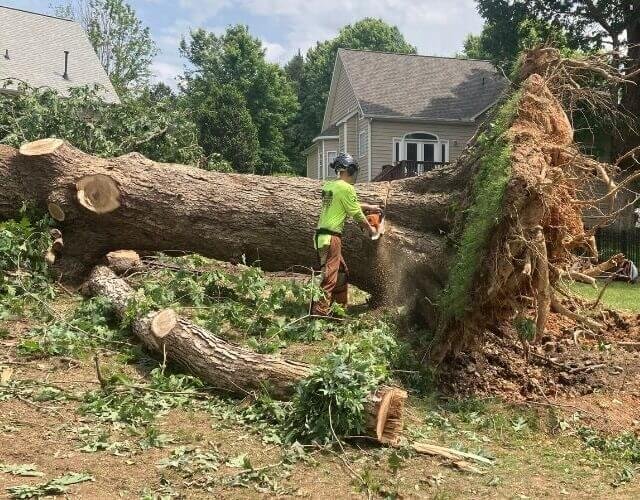
Fast, safe removal of fallen trees from roofs, fences, driveways, vehicles, and yards after storms or high winds, for homes and businesses throughout Tampa. Every job begins with an on-site assessment and a written, no-obligation estimate.
Fallen tree removal addresses a tree that's already come down — resting on a roof, draped across a fence line, blocking a driveway, or simply lying across the yard after a storm. It's a different situation than hazardous tree removal, which deals with a tree still standing but showing warning signs, and it overlaps closely with emergency tree removal when the fallen tree is actively blocking access or resting on a structure.
What makes a fallen tree genuinely tricky to deal with isn't just its size — it's the physics of how it's resting. A tree that's fallen against a fence, wedged between two other trees, or partially supported by a roofline is often holding tension and compression in ways that aren't obvious from a quick look. Cutting into the wrong section first can cause a sudden, unpredictable shift, which is exactly why fallen trees are treated as a specialized removal scenario rather than a simple cutting job.
Branches still attached to a fallen trunk can also carry their own stored energy, especially if they're pinned under the tree's own weight or caught against something else. A limb that looks harmless can spring free once the pressure holding it in place is cut, which is one of the more common ways people are injured trying to clear a fallen tree without the right experience or tools on hand.
The goal with any fallen tree is to remove it in a sequence that releases stress gradually and predictably, protecting whatever the tree is resting against and anyone working nearby. This is part of why fallen tree calls are generally handled by an experienced crew rather than treated as a straightforward cutting job — the sequence matters as much as the equipment.
Fallen trees show up in a handful of recurring situations, each with its own considerations for how removal should be approached.
Even when a fallen tree hasn't hit anything at all — simply lying across an open section of yard — it's worth having it assessed and removed within a reasonable timeframe rather than leaving it in place. A large trunk left on the ground can smother grass, create a breeding area for pests, and gradually settle in ways that make later removal more involved than it would have been shortly after the tree came down.
Weight distribution across the roofline needs to be understood before any cutting begins, to avoid worsening existing structural damage.
A tree draped across a shared fence often needs to be cut and lifted in sections to avoid further damaging the fence or nearby landscaping.
Removal has to account for the vehicle's structure underneath, cutting and lifting sections rather than dragging the tree off directly.
Access-blocking fallen trees are typically treated as a priority, since they affect daily use of the property or shared roadways.
A fallen tree touching or resting near lines is treated as an immediate hazard requiring utility coordination before work begins.
Even without hitting a structure, a large fallen tree can damage landscaping, irrigation, and turf the longer it's left in place.
Every fallen tree is approached with the same careful sequence, adjusted for how it's resting and what it's touching. See the full range of offerings on the services page.
The tree's position, tension points, and proximity to structures, vehicles, or power lines are evaluated before anything is touched.
Where needed, the tree or its remaining branches are stabilized or secured before cutting begins.
The trunk and limbs are cut in a controlled sequence that releases tension gradually rather than all at once.
Sectioned material is lifted or moved away from the structure, vehicle, or fence line it was resting against.
Limbs, trunk sections, and debris are cleared from the property as part of the job.
The affected area is reviewed for any remaining hazard or follow-up work, such as stump grinding.
Every step from hazard assessment through final cleanup is scaled to the specific situation — a small limb resting on a shed calls for far less than a mature oak spanning a driveway and a fence line at once.
Fallen tree situations look different depending on the property and what the tree came down on, and the priorities on each side of that split reflect it.
Homeowners are typically dealing with a single fallen tree affecting the house, yard, driveway, or a shared fence. Common priorities include:
See broader options for a single-property yard on the residential tree service page.
Commercial properties, HOAs, and shared communities may need to coordinate removal across multiple fallen trees at once. Common priorities include:
Learn more about ongoing maintenance on the commercial tree service page.
The first priority after a tree falls is distance, not action. Staying clear of the tree — especially if any part of it is near power lines or a damaged structure — matters more than assessing the damage up close. If the tree has come down near a utility line, treat the whole area as energized until the utility company confirms otherwise.
Photos taken from a safe distance are useful for insurance purposes, but they shouldn't come at the cost of getting closer to an unstable tree than necessary. Coverage for fallen tree removal varies by policy and by whether the tree damaged a covered structure versus simply falling in the yard, so it's worth documenting the situation and contacting your insurance provider early in the process rather than after cleanup is already underway.
If the situation involves a tree actively blocking access, resting on a structure, or otherwise requiring an immediate response, that falls under emergency tree removal rather than a scheduled visit — reach out directly rather than waiting.
A tree rarely falls for a single, isolated reason — it's usually the combination of an existing weakness and a specific trigger that finally pushes it over. In the Tampa area, a few conditions show up again and again behind fallen tree calls. Saturated, sandy soil after days of heavy rain loses much of its ability to hold a root system firmly in place, which is why trees sometimes come down during a storm's later, lower-wind phases rather than at its peak — the ground has simply given out from underneath.
Straight-line wind gusts and the outer bands of tropical systems put lateral pressure on a canopy that a tree's root system may have tolerated for years under calmer conditions. A tree that was already dealing with internal decay, a shallow root plate, or storm damage from a previous season is far more likely to be the one that finally fails, even in a storm that leaves most of the surrounding trees untouched.
Lightning strikes are another less obvious cause specific to Florida's frequent summer storm activity — a direct or nearby strike can instantly kill root tissue or split a trunk internally, sometimes without immediately visible damage above ground, which can lead to an otherwise healthy-looking tree falling weeks or months later with no storm involved at all.
Stay away from the tree and avoid touching it, especially near power lines. Take photos for insurance from a safe distance if possible, and contact a professional rather than attempting to move it yourself.
Yes, often more dangerous than it appears. A fallen tree can hold tension and compression that cause it to shift unexpectedly when cut. Fallen trees near power lines carry additional risk best left to professionals.
Response time depends on the severity of the situation and current demand, particularly after widespread storms. A tree blocking access or resting on a structure is generally prioritized.
It should be assessed by a professional before anyone attempts to move it, since shifting weight can worsen structural damage. Removal is typically done in sections to control weight distribution.
Yes, though responsibility for cost may depend on where the tree originated and the specific circumstances, which is worth discussing with your insurance provider.
Coverage varies by policy. A tree that falls due to a storm and damages a covered structure is often eligible for a claim; removal with no property damage may or may not be covered.
In most cases, no. Once a tree has fully fallen, its root system is typically too disturbed to recover, and the focus shifts to safe removal and cleanup.
Yes. A free, no-obligation estimate can be requested through the estimate form on this site or by phone. You can also reach out through contact or confirm coverage on the service areas page.
See the full list of services on the services page, or check the service areas page to confirm coverage near you.
Quick Request
Can't connect with us by phone? Message us with the service you need. Send your request and we'll get back to you within 15 minutes.