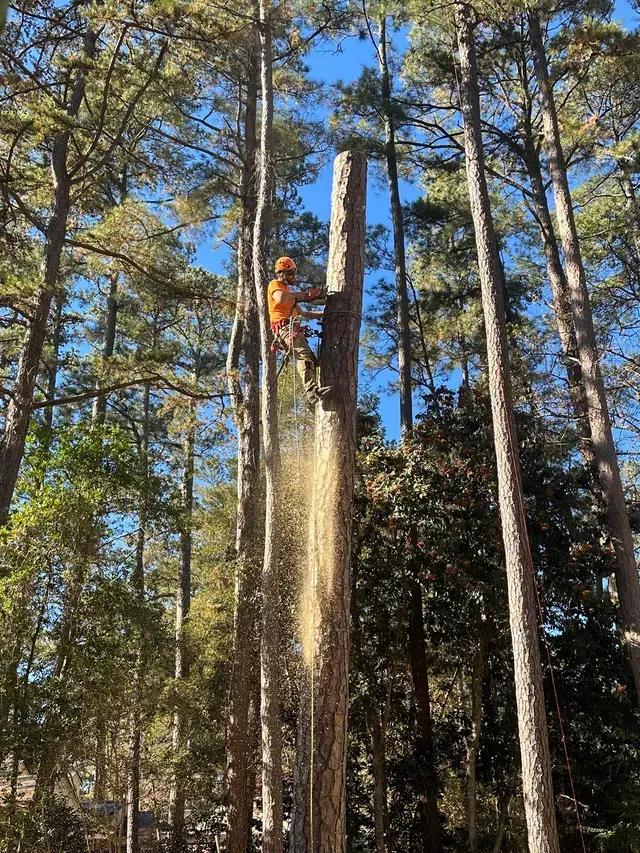
Tampa, Florida

Pine Tree Removal in Tampa, FL

Removal of tall, leaning, beetle-damaged, or storm-weakened pines for homes and businesses across Tampa, with attention to the height and root characteristics that make pines behave differently than other trees.

Pine tree removal in Tampa, Florida
Tall, Fast-Growing, and a Little Unpredictable

Why Pine Removal Gets Its Own Approach

Slash pines and loblolly pines show up often on Tampa-area properties, usually growing quickly into tall, narrow trees with most of their branching concentrated near the top. That shape is part of what makes pine tree removal a different job from removing a broad hardwood. There's less canopy to rig from lower down, more height to manage overall, and a root system that, compared to the tree's height, tends to run shallower than people expect.

That shallow-rooted, top-heavy combination is exactly why pines are so often the first trees to go down in a strong storm, even when nearby oaks or other hardwoods come through unscathed. A pine doesn't have to be dead or diseased to become a hazard — sometimes it's simply tall, exposed to wind, and standing in soil that's been saturated by weeks of Florida rain.

None of this makes pines inherently dangerous trees to have on a property. Most stand for decades without incident. But when one does need to come down — because it's dead, leaning, beetle-damaged, or simply too close to a structure for comfort — the height and root characteristics change how the removal has to be planned compared with a typical hardwood job. A tree that could safely be dropped whole in an open field often has to be taken down in carefully measured sections once a house, fence, or driveway is within reach of its full height.

Signs to Watch For

Signs a Pine May Need Removal

A few warning signs come up often enough with pines that they're worth knowing, whether the tree is on a residential lot or lining a commercial property.

🐛

Beetle Damage

Small resin blobs on the bark, reddish boring dust near the base, or bark that peels away easily can all point to bark beetle activity.

🍂

Browning From the Top Down

Needles fading or turning brown starting at the crown, rather than scattered throughout, often signals a tree in serious decline.

📐

New or Increasing Lean

Because of their shallow roots, pines can develop a lean fairly suddenly, especially after heavy rain has softened the surrounding soil.

🪵

Bark Loss or Sap Streaking

Patches of missing bark or heavy sap running down the trunk can indicate injury, insect activity, or advancing decay underneath.

Growth Into Power Lines

Given how tall pines get, their upper limbs sometimes end up growing into overhead utility lines well before the trunk itself becomes a concern.

🏠

Height Relative to Structures

A pine tall enough to reach a roofline if it fell is worth having assessed, even if the tree currently looks perfectly healthy.

How It Works

Our Pine Tree Removal Process

Height, not just weight, drives most of the planning behind a pine removal.

01

Height & Lean Assessment

The tree's total height, direction of lean, and proximity to structures or lines are measured and evaluated on-site.

02

Root & Soil Check

Soil conditions and any visible root lifting are reviewed, since saturated ground affects how stable the tree currently is.

03

Method Selection

Depending on space and height, the tree may be felled in one controlled cut, taken down in sections, or removed with crane assistance.

04

Controlled Removal

The tree or its sections are brought down using rigging and cutting techniques suited to its height and lean.

05

Debris Removal

Trunk sections, limbs, and needles from the removal itself are cleared from the property.

06

Stump Grinding

Pine stumps can be ground down separately or scheduled as part of the same visit, depending on the job.

Property Types

Single Pines & Commercial Pine Stands

Pines show up both as individual yard trees and as denser stands along commercial and multi-family properties, and the concerns tend to differ between the two.

Residential Pine Removal

For a single pine in a yard, the main question is usually how the tree relates to the house and any nearby structures. Typical considerations:

  • Whether the tree's height puts it within striking distance of the roof
  • Root lifting near a foundation, patio, or driveway
  • Access for felling or crane work in a residential lot
  • Whether a single healthy pine is worth keeping with routine monitoring instead

Commercial Pine Stands

Commercial sites, apartment complexes, and HOA-managed common areas often have rows or clusters of pines planted together decades ago. Considerations include:

  • Identifying which trees in a stand are declining versus healthy
  • Prioritizing removal near parking, walkways, or buildings first
  • Scheduling work with minimal disruption to tenants or customers
  • Coordinating a broader risk review rather than reacting tree by tree

Properties with a larger stand of aging pines may benefit from a full arborist assessment to prioritize which trees need attention first, or ongoing commercial tree service to manage the stand over time. Waiting until several trees in a stand show visible decline at once usually means more removals, more disruption, and a bigger bill than catching problems one or two trees at a time.

Wind & Weather

Why Pines Are Often First to Fall in a Storm

Anyone who's driven around Tampa after a strong storm has probably noticed the same pattern: pines are frequently among the first trees down, even in yards where sturdier hardwoods stayed standing. The combination of height, a relatively narrow canopy that catches wind at the top, and roots that don't spread or anchor as deeply as many hardwoods leaves pines more exposed to toppling, particularly once the ground has been softened by heavy rain.

This doesn't mean every pine is at risk every time it storms — plenty of healthy pines with solid root systems ride out severe weather without issue. But it does mean that a pine already showing signs of stress, lean, or root disturbance deserves more urgency than the same symptoms might on a slower-growing, more deeply rooted species.

Height vs. Wind Exposure

Taller pines catch more wind load higher up, increasing the leverage acting on the trunk and roots below.

Shallow Rooting

Pine root systems often spread wide but not especially deep, offering less anchoring in saturated soil.

Saturated Ground Risk

Extended rain ahead of a storm can loosen soil enough that even a healthy pine's roots lose some of their grip.

Early Assessment Value

Catching a lean or root issue before storm season gives more options than waiting until after a tree has already gone down.

Not All Trees Are the Same

Pine Removal vs. Oak Removal: Key Differences

Pines and oaks are two of the most common large trees on Tampa properties, but they behave differently enough that removal is approached differently for each.

FactorPine TreesOak Trees
Typical shapeTall and narrow, branching near the topBroad, spreading canopy
Root depthOften shallower relative to heightWide-spreading, generally sturdier anchoring
Storm vulnerabilityHigher risk of toppling in windMore resistant, though large limbs can still fail
Common local protection statusLess frequently protected by ordinanceFrequently protected, permit often required
Typical removal methodFelling or sectional drop, crane if neededSection-by-section canopy removal
Growth rateFast-growingSlow-growing, long-lived

For comparison, see how oak tree removal is approached, or how crane tree removal applies when a pine's height or position makes standard felling impractical.

Frequently Asked Questions

Pine Tree Removal FAQs

Why do pine trees fall over more easily than other trees?

Many pines have a relatively shallow root system compared to their height, which can make them more prone to toppling in high wind, especially when the soil is already saturated from heavy rain.

How do I know if a pine tree is infested with beetles?

Signs can include small resin blobs on the bark, reddish-brown boring dust near the base, fading or browning needles starting at the top, and bark that separates easily from the trunk. A professional inspection is the most reliable way to confirm beetle activity.

Is pine tree removal different from oak or hardwood removal?

Pines tend to be tall and narrow with less lateral branching to rig from, so the approach often relies more on controlled felling or crane assistance rather than the section-by-section canopy work typical of broad hardwoods like oaks.

Do I need a permit to remove a pine tree in Tampa?

Permit requirements depend on the specific tree, its size, and its location, and can vary between pines and other protected species like mature oaks. Confirm with the City of Tampa or Hillsborough County permitting office before removal.

Can a dead pine be left standing if it's not near anything?

A dead pine in a truly open area with no structures, power lines, or walkways nearby carries less immediate risk, but dead pines can fail unpredictably and should still be assessed as they continue to dry out over time.

What happens if a pine is leaning toward power lines?

A leaning pine near power lines should be treated as an active hazard. The utility company is typically notified, and the area is kept clear until the tree can be safely assessed and removed by trained crews.

Are pine needles and cones included in removal cleanup?

Trunk sections, limbs, and larger debris from the removal are typically hauled away as part of the job. Ongoing needle and cone drop from surrounding pines is a separate, recurring yard maintenance matter rather than part of a one-time removal.

How tall can pines get in the Tampa area, and does that affect removal?

Mature pines in this area can reach well over 60 feet, and height significantly affects removal planning, since taller trees may require sectional felling, crane assistance, or extra clearance from structures and utility lines.

Related Services

Explore Related Tree Services

See the full list of services on the services page, confirm coverage on the service areas page, or reach out through the contact page with any questions. For pines damaged in a recent storm, storm cleanup covers the debris side once any hazard has been addressed.

Have a Pine Tree That Needs a Closer Look?

Request a Free Estimate Today