Safe removal of standing dead trees for homes and businesses across Tampa, plus straightforward guidance on how to tell a dead tree from one that's simply dormant or stressed.
A living tree, even a stressed or damaged one, still has some flexibility built into its wood — branches bend, sway, and generally give some warning before they fail. A dead tree doesn't have that. Once wood dries out and decay sets in, it becomes brittle and far less forgiving, which means a dead tree can drop a limb, or come down entirely, with little to no warning even on a calm day.
That unpredictability is the main reason dead tree removal tends to get prioritized over other tree work. It's not that a dead tree is guaranteed to fail on any given day — plenty stand for years — but the margin for error is smaller, and the consequences of misjudging a dead tree's stability are generally more serious than misjudging a living one.
Removal itself follows many of the same principles as any other tree removal, but the assessment leading up to it looks a little different. Instead of asking whether the tree can be saved through pruning or treatment, the question is simply how to bring it down safely, since a fully dead tree isn't a candidate for the kind of health-focused interventions that apply to a struggling but living one.
Not every bare or unhealthy-looking tree is dead — some are dormant, stressed, or recovering from damage. A handful of signs, especially in combination, point more reliably to a tree that's no longer alive.
A tree that stays completely bare through what should be its normal growing period is one of the clearest signs of death.
Bark that's dry, loose, or falling away in large sections often means the living layer underneath has died.
A small scratch test on a twig revealing dry, brown tissue rather than green, moist tissue is a strong indicator of death in that section.
Shelf fungi or mushrooms across the trunk, rather than in just one small spot, often signal advanced decay throughout the tree.
Small, evenly spaced holes across the trunk can point to wood-boring insects that typically target already-weakened or dead wood.
Small branches that snap cleanly rather than bending under light pressure are usually dry and dead rather than simply dormant.
Because dead wood behaves unpredictably, extra caution is built into each stage of the process.
The tree is checked to confirm it's genuinely dead rather than dormant, stressed, or partially affected.
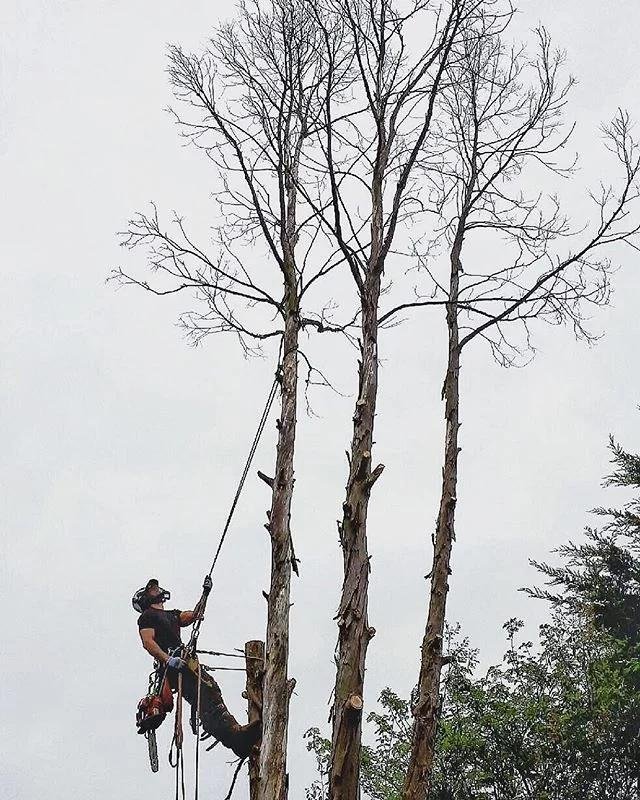
Trunk stability, decay extent, and brittleness are assessed before anyone climbs or rigs the tree.
Nearby structures, fences, and power lines are mapped out to plan the safest cutting sequence.
Sections are cut and lowered with extra care given to the reduced flexibility and predictability of dead wood.
Trunk sections, limbs, and brush are cleared from the property once the tree is fully down.
Stump grinding can be scheduled separately or as part of the same visit to complete the job.
Confusing a stressed or dormant tree for a dead one — or the other way around — is common, especially with species that naturally lose most of their leaves for part of the year. The comparison below covers the more reliable distinctions.
| Sign | Dead Tree | Dormant / Stressed Tree |
|---|---|---|
| Leaf-out during growing season | Does not occur | Delayed or reduced, but eventually occurs |
| Twig scratch test | Dry, brown underneath | Green, moist underneath |
| Bark condition | Loose, falling, or absent in patches | Intact, even if discolored |
| Small branch flexibility | Snaps cleanly, no give | Bends before breaking |
| Fungal growth | Often widespread across the trunk | Usually absent or very limited |
| Recommended action | Removal assessment | Monitoring or treatment first |
When it's genuinely unclear which category a tree falls into, an arborist assessment is the most reliable way to get a clear answer before deciding on removal.
Dead trees raise a few practical questions that don't come up as often with routine tree work, particularly around who's responsible for a tree and what happens if it fails. Responsibility for a tree generally follows the property line it's rooted on, which matters when a dead tree on one property leans toward or overhangs a neighboring one.
Insurance coverage for damage caused by a fallen dead tree varies by policy, and some insurers look at whether the tree's poor condition was known or reasonably apparent beforehand. That's part of why documenting a dead tree's condition — and acting on it rather than letting it sit indefinitely — tends to matter more than it would for a tree that failed with no visible warning signs.
Knowing whose property a dead tree sits on helps clarify responsibility before a dispute arises.
A direct conversation is usually the simplest first step when a dead tree affects a shared boundary.
Photos and notes on a dead tree's condition can support an insurance conversation if the tree later causes damage.
Addressing a known dead tree sooner rather than later reduces both physical risk and potential liability questions.
A single dead tree in a backyard is a different situation than a dead tree standing over a parking lot or shared walkway.
For homeowners, the main concerns usually center on the tree's position relative to the house and daily foot traffic:
Businesses and property managers often have less flexibility to simply monitor a dead tree over time:
Multi-site or portfolio properties dealing with several aging or declining trees may also benefit from commercial tree service to review risk across the whole site rather than tree by tree.
A simple scratch test on a small twig can help: green, moist tissue underneath the bark usually means the branch is still alive, while dry, brown tissue suggests it's dead. A full lack of leaf-out during the growing season, brittle bark that falls away easily, and widespread fungal growth are also strong indicators.
Living wood has some flexibility that helps it bend and absorb stress in wind. Dead wood loses that flexibility and becomes brittle, meaning branches and even entire trunks can fail suddenly and with far less warning than a living tree typically gives.
It depends on the tree's location. A dead tree near a home, driveway, walkway, or property line generally warrants prompt attention, while one in a truly open area away from structures may carry a lower immediate risk, though it should still be assessed.
Cost depends more on size, condition, and access than on whether the tree is alive or dead, though a dead tree's brittleness and unpredictability can sometimes require extra caution and rigging adjustments during removal.
Responsibility for a tree generally follows property lines, so a conversation with the neighbor is usually the first step. If the tree poses an immediate hazard, documenting the situation and discussing options with a professional can help clarify what to do next.
In some cases, a dead tree far from any structure is left standing intentionally because it provides habitat for woodpeckers and other wildlife. This is a property owner's choice after weighing the ecological benefit against the risk, and it isn't appropriate near homes, driveways, or walkways.
Sometimes. A tree with a dead section limited to certain limbs, while the trunk and root system remain healthy, may be treatable through pruning rather than full removal. An arborist assessment is the best way to determine which situation applies.
Coverage varies by policy, and insurers sometimes look at whether the tree's condition was known or reasonably foreseeable beforehand. Checking with your provider about your specific policy is the most reliable way to understand your coverage.
See the full list of services on the services page, confirm coverage on the service areas page, or reach out through the contact page with any questions.
Quick Request
Can't connect with us by phone? Message us with the service you need. Send your request and we'll get back to you within 15 minutes.